A whiter, more beautiful smile is one of the most common wishes of people looking to improve the look of their teeth. After all, your smile is one of your best calling cards, able to convey confidence and self-esteem and even open doors in personal and professional settings. Among the most sought-after cosmetic procedures in dental clinics, teeth whitening stands out, precisely because it delivers visible results quickly and has a big impact on appearance.
However, whitening is not always done exclusively in the dental office. There are also options carried out at home, known as at-home whitening, which have won over many patients because they are practical and more affordable. Both techniques have their strengths and particularities, which should be carefully considered before making a decision.
So, which is the best choice: at-home or in-office teeth whitening? To answer this question, it is essential to understand in detail how each technique works, its indications, benefits and limitations, and even the care needed to ensure the treatment is safe.
In this article, we explain everything you need to know to choose the most suitable option for your case, with evidence-based information and the experience of the specialists at Fontes Odontologia, a leading clinic in Ipanema that combines cutting-edge technology with caring service to deliver effective, long-lasting results.
How does each type of whitening work?
Teeth whitening is a cosmetic treatment that uses whitening agents — usually based on hydrogen peroxide or carbamide peroxide — to remove stains and pigments that build up in the tooth enamel. These pigments can be caused by factors such as coffee, wine, soft drinks, tobacco, foods with colorings and even the natural aging of the teeth.
There are two main types:
At-home teeth whitening
At-home whitening is carried out with custom trays (or, in some cases, prefabricated trays) that the patient wears daily at home, applying whitening gel at lower concentrations than those used in the office. Treatment usually lasts 2 to 4 weeks, depending on how dark the teeth are and the dentist’s recommendation.
Even though it is done at home, this method should always be supervised by a dentist, who explains how to use it correctly and monitors the results.
In-office teeth whitening
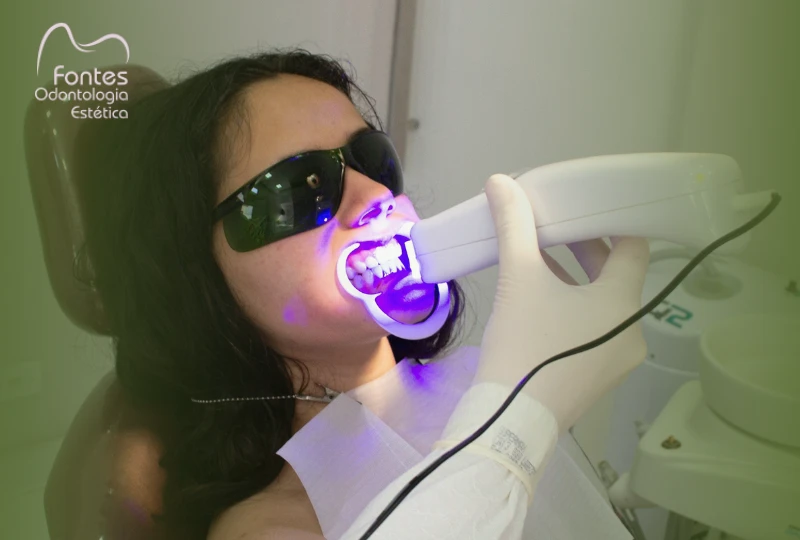
In-office whitening is carried out directly at the clinic, using higher-concentration gels for fast, effective results.
The dentist usually protects the gums with special barriers and applies the whitening agent directly to the teeth, and may or may not use light or laser sources to boost the effect.
Treatment usually takes 1 to 3 sessions, depending on the case, and the results appear almost immediately.
Differences between at-home and in-office whitening
Although both methods share the same goal — whitening the teeth and improving the look of the smile — the differences between them are considerable and can directly influence the patient’s choice. Understanding each characteristic is essential to make the right decision. Here are the main points:
Whitening gel concentration
- At-home: uses lower concentrations, usually between 10% and 22% carbamide peroxide. Because it is less potent, it can be used for longer periods safely, reducing risks and making it a good option for those who prefer to whiten gradually, in the comfort of home.
- In-office: uses higher concentrations, up to 40% hydrogen peroxide. This potency provides much faster, more noticeable whitening and is indicated for those seeking visible results in a short time.
Treatment time
- At-home: whitening happens progressively, with daily use of custom trays. The process usually takes 2 to 4 weeks, depending on the need and the degree of discoloration.
- In-office: results can be seen after the first session, with treatment completed in up to 3 appointments. It is a practical alternative for those who want an immediate result without daily applications.
Control of the process
- At-home: depends entirely on the patient’s discipline in following the dentist’s instructions correctly, such as wearing time and dietary care during treatment.
- In-office: is fully controlled by the dentist, who applies the product, monitors how the teeth react and ensures greater safety and predictability of results.
Risk of sensitivity
- At-home: because it works more slowly and at lower concentrations, it usually causes less sensitivity, making it a more comfortable option for patients with sensitive teeth.
- In-office: may cause more intense temporary sensitivity, mainly due to the high gel concentration and rapid action. However, the dentist can use desensitizing products and techniques to minimize this discomfort.
Results
- At-home: offers a satisfying result, with subtler, gradual whitening, ideal for those seeking a natural, progressive transformation.
- In-office: delivers more intense, faster whitening, perfect for those who want visible changes quickly or need the procedure for a special occasion.
Pros and cons of each whitening option
To help you decide, we have listed the advantages and disadvantages of each technique:
At-home whitening
Pros:
- More affordable.
- Greater patient control over the routine.
- Gradual whitening, reducing the risk of sensitivity.
- Can be used for maintenance after professional whitening.
Cons:
- Slower results.
- Risk of improper use when done without supervision.
In-office whitening
Pros:
- Fast, more intense results.
- Constant monitoring by the dentist.
- Gum barriers that protect the soft tissues.
- Indicated for more stubborn stains.
Cons:
- Higher cost.
Who can have their teeth whitened?
Although teeth whitening is considered a safe and widely used procedure, it is important to note that not every patient is ready for it right away. Every smile has its own particularities, which is why treatment must be preceded by a thorough assessment by a dentist, who can identify specific needs and determine whether the procedure is indicated at that time.
Indications for teeth whitening
Whitening is especially recommended for:
- Adults with stained teeth: color changes caused by frequent consumption of pigmented foods and drinks such as coffee, tea, wine and soft drinks, or by smoking.
- Patients whose teeth have darkened with age: over time, tooth enamel becomes thinner and the naturally yellowish dentin becomes more visible, making whitening an excellent option.
- Color changes after root canal treatment: teeth that have had root canal treatment can darken, and internal or external whitening can restore a more natural color to the smile.
- People with good oral health: individuals without active cavities, gum inflammation or periodontal problems, so that whitening can be done safely and effectively.
Contraindications for teeth whitening
Treatment is not recommended in some specific situations, such as:
- Pregnant and breastfeeding women: as there are no conclusive studies on the safety of whitening during pregnancy and breastfeeding, the procedure should be postponed.
- Children and teenagers whose teeth are still developing: in these cases, it is necessary to wait until the teeth and gum tissue are fully mature before considering treatment.
- Patients with cavities, fractures or faulty restorations: these conditions must be treated first to avoid complications such as pain or marked sensitivity.
- People with extreme tooth sensitivity: before whitening, the dentist may recommend desensitizing therapies to make the procedure more comfortable and safe.
Want whiter teeth? ✨ Find the best whitening option for you at Fontes Odontologia in Ipanema!
Teeth whitening can transform your smile and boost your self-esteem, but the choice between at-home and professional whitening depends on your needs, expectations and your dentist’s recommendation.
At Fontes Odontologia, located in Ipanema, we have a team of cosmetic dentistry specialists, cutting-edge technology and modern whitening protocols to deliver safe, fast and natural results.
Why choose Fontes Odontologia?
- A personalized assessment to determine the most suitable type of whitening.
- Combined options (at-home + in-office) to boost results.
- Caring service, with follow-up before, during and after treatment.
- Modern facilities to ensure comfort and safety.
📍 Address: R. Visc. de Pirajá, 351 – room 801 – Ipanema, Rio de Janeiro
📞 Book your appointment now! Find out how we can transform your smile with safe, effective teeth whitening.
🦷 Related treatment in Ipanema: Teeth Whitening