


In a neighborhood like Ipanema, where image and presence are part of everyday life — whether in meetings, social events or professional life — the smile plays a central role. Small imperfections, such as slight misalignment, stains or differences in shape, can affect the way a person expresses themselves.
Ultra-thin dental veneers (known in Brazil as “dental contact lenses”) are a precise aesthetic solution for these cases.
Unlike more invasive procedures, a veneer is an ultra-thin, custom-made sheet of porcelain or ceramic that covers the front of the tooth to improve its shape, color and proportion. The result aims for naturalness, respecting the individual features of the face and smile.
At Fontes Odontologia, in Ipanema, treatment is carried out with digital planning and detailed aesthetic analysis, taking into account facial harmony, the smile line and the patient’s expectations. It is not just about “whitening” or “visually aligning”, but about adjusting proportions with technical precision.
On this page, you will learn:
What ultra-thin dental veneers are and how they work
Who they are indicated for
The difference between ultra-thin veneers and conventional veneers
How aesthetic planning is done
How long they last and how to maintain them
If you are looking for a predictable aesthetic solution focused on naturalness and personalization, it is worth understanding each step before deciding.
What are ultra-thin dental veneers?
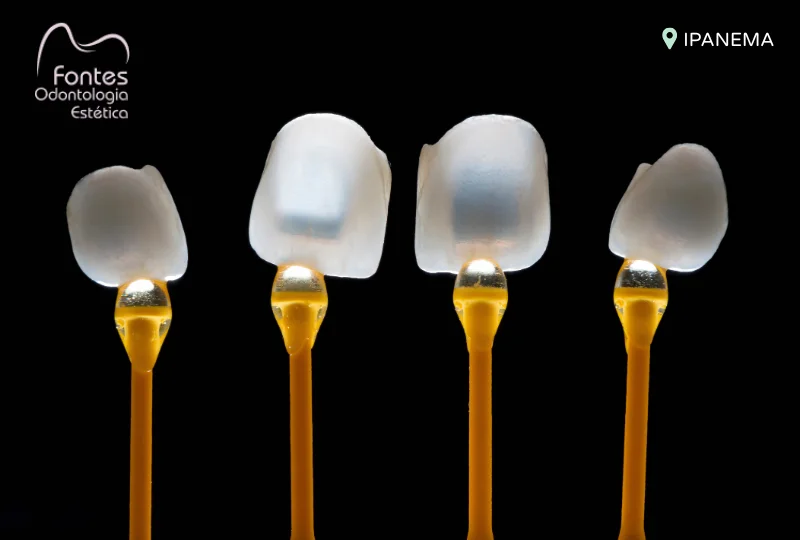
An ultra-thin dental veneer is a very thin sheet of porcelain or ceramic applied to the front of the tooth to correct specific aesthetic issues.
In Brazil it is called a “dental contact lens” because its thickness is comparable to that of an eye contact lens: extremely thin, yet highly resistant when correctly indicated and placed. In many cases, tooth preparation is minimal or unnecessary, preserving the natural structure.
How do veneers work?
The principle is simple: add, rather than remove.
The veneer is digitally planned to adjust:
Tooth shape
Slight misalignment
Gaps between teeth (mild diastemas)
Stains that do not respond to whitening
Asymmetry between neighboring teeth
It does not replace the tooth, as prostheses do, nor does it involve extensive grinding like some traditional veneers. The aim is aesthetic refinement.
How do ultra-thin veneers differ from other procedures?
Ultra-thin veneers are usually indicated when the goal is to improve proportion, even out color and correct small details.
When larger structural changes are needed, such as extensive reconstruction, other approaches may be considered.
If your question is specifically about how the types compare, we recommend reading the section further below: Ultra-thin or conventional veneers? Understand the differences.
Why is porcelain used?
Porcelain veneers are widely chosen because they:
Reflect light in a similar way to natural enamel
Keep their color stable over time
Have adequate strength when properly indicated
Allow a fine, natural finish
In aesthetic planning at Fontes Odontologia, the choice of material takes into account skin tone, face shape and the smile line, avoiding artificial or standardized results.
Dental veneers are not a generic procedure. They are a personalized treatment that depends on accurate diagnosis and careful execution.
Before and After Results with Dental Veneers
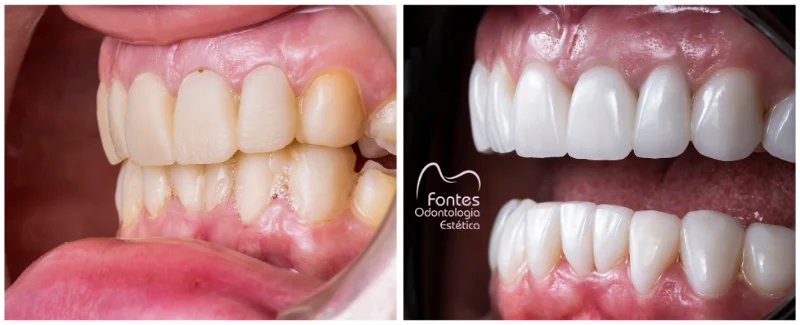
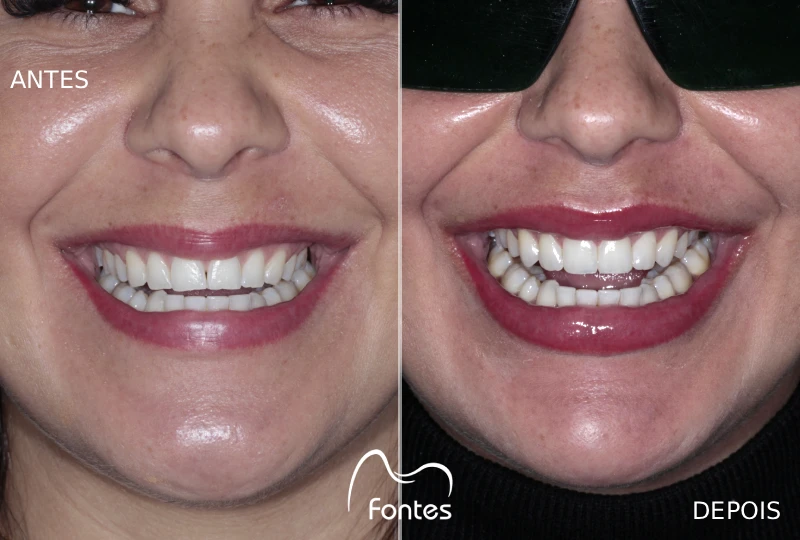
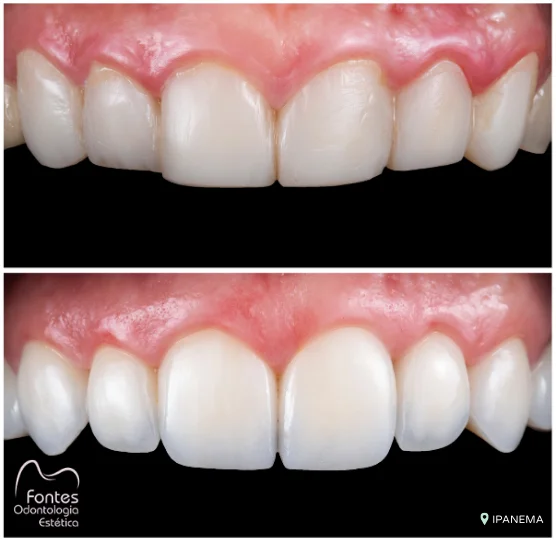
Who are dental veneers for?
Ultra-thin dental veneers are not indicated for every case — and that is an important point.
They work best when the goal is to refine the look of the smile, with no need for major structural reconstruction. The focus is on harmony, proportion and visual uniformity.
Most common indications
Veneers are usually recommended for patients who have:
Permanently stained teeth that do not respond to whitening
Slight misalignment (with no need for braces)
Small gaps between teeth (mild diastema)
Differences in size between neighboring teeth
Worn or irregular edges
Slight asymmetry in tooth contour
In these cases, the veneer acts as a fine adjustment, visually reshaping form and proportion.
When they are not the best choice
There are situations in which veneers may not be the ideal treatment, such as:
Severe misalignment
Extensive loss of tooth structure
Significant bite problems
Uncontrolled bruxism
In these conditions, it may be necessary to treat the functional cause first before thinking about aesthetics.
At Fontes Odontologia, in Ipanema, veneers are never recommended automatically. Each case undergoes clinical analysis, digital assessment and a discussion of expectations. The goal is not to “put on veneers”, but to recommend the solution that best fits the patient’s condition.
Is there an ideal age?
There is no specific age, but it is essential that:
Facial growth is complete
Gum health is under control
The patient understands the limitations and maintenance
For adults who want to improve their smile without invasive procedures, veneers are often a conservative and predictable alternative.
In many cases, they are also chosen by those seeking an aesthetic result with minimal change to the natural structure.
If your goal is to improve shape, color or small details without resorting to more extensive interventions, veneers may be a viable option.
Ultra-thin vs. conventional veneers: is there a difference?
In Brazil, the terms dental contact lens, porcelain lens and porcelain veneer are often used interchangeably. For most patients, they all refer to ceramic sheets applied to the teeth for aesthetic purposes.
In clinical practice, there may be small technical variations related to the thickness of the piece and the amount of tooth preparation. Some porcelain veneers are extremely thin and require minimal intervention on the enamel. Other reshaping may require slightly more preparation, especially when classified as conventional veneers.
What really matters is not the commercial name used, but the planning.
The goal is to achieve proportion, visual alignment and facial harmony while respecting the existing tooth structure. In many cases, someone searching for ultra-thin porcelain veneers is looking for the same procedure that could technically be described as a conventional veneer — and vice versa.
At Fontes Odontologia, in Ipanema, the approach is not defined by the label. It is defined by the diagnosis.
During aesthetic planning, we assess the structural condition of the tooth, its position in the arch, the expected result and biological limits. Based on this analysis, we define the most suitable type of ceramic veneer to achieve the desired result safely.
Whether you are searching for ultra-thin veneers, porcelain veneers or simply want to improve your smile, the most important thing is to understand that the recommendation is personalized.
How aesthetic planning is done
Dental veneers do not start in the dental chair. They start with planning.
In well-conducted aesthetic treatment, especially at a clinic like Fontes Odontologia, in Ipanema, execution only happens once the result has been carefully studied.
1. Detailed clinical assessment
The first step is to understand the starting point.
At this stage, we analyze:
Enamel structure and integrity
Tooth alignment
The relationship between teeth and gums
Occlusion (how the teeth fit together)
Any wear or fractures
Not every case can or should receive veneers immediately. If there are functional issues, they need to be addressed before the aesthetic part.
This analysis prevents artificial or unstable results.
2. Digital smile design
Today, aesthetic planning is done with digital support.
Photographs, intraoral scanning and facial analysis make it possible to simulate proportions, alignment and volume even before the ceramic veneers are made. This helps predict how the veneer will look together with the patient’s face and expression.
More than “whitening”, the goal is harmony.
The ideal width of each tooth, the curve of the smile and the balance with the lips are all considered at this stage. Small adjustments make a difference to the final natural look.
3. Mock-up and aesthetic trial
In many cases, it is possible to do a preview called a mock-up.
This stage involves applying a temporary simulation to the teeth so the patient can see the proposed shape before the final veneers are made. This allows fine-tuning and greater predictability.
The patient takes part in the process.
This involvement reduces regret and increases confidence in the decision.
4. Custom laboratory fabrication
Once the plan is approved, the veneers are made in a specialized laboratory.
Here, details such as:
Surface texture
Translucency
Shade
Thickness
are defined individually.
There is no standard veneer. Each piece is custom-made.
5. Placement and final adjustment
The final stage involves carefully bonding the porcelain veneer to the tooth.
The bite is checked and the finish is refined to ensure a precise fit and comfort. Small details of polishing and alignment directly influence durability and the aesthetic result.
When planning is well executed, placement is no longer a moment of improvisation but simply the final stage of a process that has already been defined.
In a neighborhood like Ipanema, where many patients seek discretion and naturalness, planning is what distinguishes a well-executed smile from a noticeably artificial result.
Durability and maintenance
A common question from those considering dental veneers is: how long do they last?
The answer does not depend only on the material. It depends on the correct indication and the care taken after the procedure.
How long can they last?
When well planned and correctly bonded, veneers can last many years. The porcelain used offers color stability and adequate strength for daily use, as long as the patient keeps up regular check-ups.
What compromises durability is not the technique itself, but factors such as:
Uncontrolled bruxism
Lack of preventive maintenance
Repeated trauma
Inadequate hygiene
That is why the initial assessment needs to consider habits and bite pattern before placement.
Can veneers stain?
Porcelain veneers do not stain the way natural enamel does.
Drinks such as coffee, wine or soft drinks do not easily change the color of the ceramic. However, the gums and surrounding natural teeth are still subject to staining, which reinforces the importance of regular check-ups and professional cleanings.
Maintenance is not complicated, but it does require discipline.
What should daily care look like?
Caring for veneers is similar to caring for natural teeth:
Proper brushing
Flossing
Regular check-ups
Not using your teeth as tools (to open packaging, for example)
There is no need for special products or a different routine. What changes is attention to detail.
Is there a risk of a veneer coming off?
When the bonding protocol is correctly carried out and the bite is balanced, the risk is low.
Even so, any dental restoration is subject to wear over the years. Small adjustments can be made during regular check-ups to preserve the result.
At Fontes Odontologia, in Ipanema, follow-up is part of the process. Treatment does not end when the veneer is placed; it includes monitoring to ensure aesthetic and functional stability.
Durability is directly linked to the correct indication and regular maintenance.
More frequently asked questions about dental veneers
Do veneers wear down the tooth?
In most cases, preparation is minimal or unnecessary.
The aim of ultra-thin dental veneers is to preserve as much of the natural structure as possible. When preparation is needed, it is limited to the enamel surface, respecting biological limits and maintaining the integrity of the tooth.
Can a veneer break?
The porcelain used is strong, but not indestructible.
Like natural teeth, it can be damaged by trauma or excessive load. That is why habits such as nail biting, biting objects or untreated bruxism should be assessed before the procedure.
Can veneers be replaced in the future?
Yes. If there is an aesthetic or functional need, veneers can be replaced, as long as the tooth structure has been preserved.
Does getting veneers hurt?
The procedure is minimally invasive and, when preparation is needed, it is done under local anesthesia. Most patients report feeling comfortable throughout.
Will the result look artificial?
When planning does not consider proportion and facial harmony, the result can look artificial.
That is why, at Fontes Odontologia, the focus is on naturalness. Color, shape and alignment are defined based on individual anatomy, avoiding excessive standardization. The goal is not to “change your smile”, but to adjust it in a way that suits your face.
Can veneers be removed later?
Veneers are not a temporary procedure.
Although the pieces can be replaced or redone in the future, the treatment is planned as a long-term solution. The decision should be made knowing that it involves a permanent aesthetic intervention.
Do I need veneers on all my teeth?
Not necessarily.
Treatment often involves only the teeth that show when you smile. The number of veneers is defined based on the aesthetic analysis and the desired symmetry.
Each case is planned individually.
Your smile should reflect who you are

Choosing dental veneers is not just an aesthetic decision. It is a decision about image, confidence and presence.
In Ipanema, where many of our patients lead active, socially visible professional lives, the smile is often part of how they communicate. Small asymmetries, stains or details of shape can bother people more than it seems — especially when the expectation is a natural look.
The purpose of veneers is not to standardize. It is to adjust.
At Fontes Odontologia, each case is planned with facial analysis, dental proportion and functional predictability. The goal is a result that suits your profile, without exaggeration or artificiality. The treatment involves technique, but also listening and personalization.
If you are considering improving the shape, color or harmony of your smile with veneers, the first step is a careful assessment to understand whether this is the most suitable approach for your case.
📍 We are in Ipanema, providing care for those who seek aesthetic precision and attentive follow-up.
If it makes sense for you, book your assessment and talk to our team about the possibilities.
📚 Read also: Resin vs. porcelain veneers
🦷 Related treatments: Diastema Closure · Teeth Whitening
3D Technology and Digital Planning
We use intraoral scanning and advanced software to simulate results, predict movements and ensure precise alignment at every stage of treatment.

Personalized Follow-up
Each patient receives an exclusive orthodontic plan, with continuously monitored adjustments to ensure predictable and efficient results.

Comfort and Discretion
Invisible aligners allow for a hassle-free routine, with fewer appointments, no metal wires and no impact on the look of your smile during treatment.

Specialized Orthodontics
Our team is trained in modern orthodontic protocols and has experience treating simple, moderate and complex cases with Invisalign.