When someone searches for dental implant techniques, the question is no longer “which type to choose”, but how the procedure is carried out.
After understanding whether the case requires a single, multiple or full-arch implant, the natural next step is to understand the surgical method. This is where terms such as immediate loading, guided surgery, bone grafting and even specific approaches such as the All-on-4 protocol come in. Each technique addresses a different clinical condition and influences treatment time, predictability and planning.
It is important to separate two concepts:
- Type of implant → refers to the structure of the rehabilitation (how many teeth are replaced).
- Implant technique → refers to how the procedure is performed.
This article focuses exclusively on techniques.
Throughout the article, you will learn:
- What immediate loading is and when it may be indicated
- How computer-guided surgery works
- When a bone graft is needed
- When an implant can be placed without a graft
- How the professional chooses the ideal technique for each case
The aim is to explain, objectively, the main approaches used in modern implant dentistry, without comparing types or going into details that belong on the specific treatment pages.
Before discussing the best-known techniques, it makes sense to start with the one that generates the most interest in searches: immediate loading.
1. Immediate loading
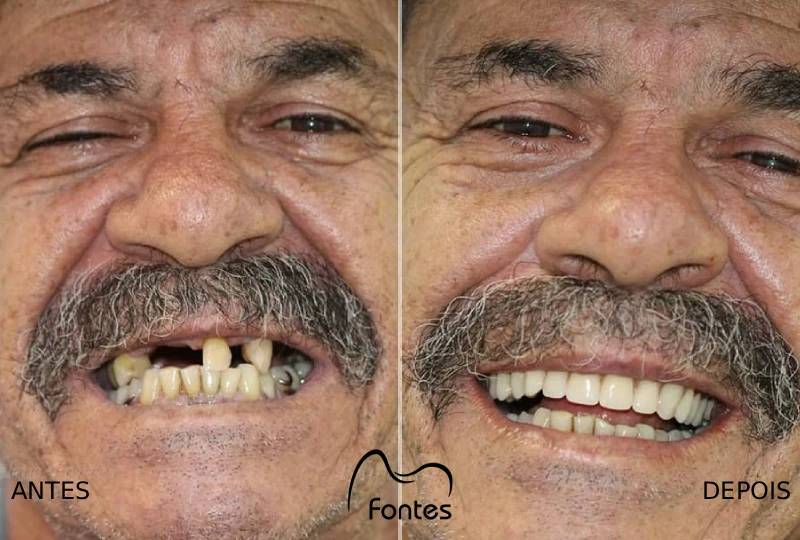
Immediate loading is one of the most searched-for techniques in implant dentistry.
It involves fitting a temporary prosthesis within a short time after the implant is placed — often on the same day or within a few days. Unlike the traditional protocol, in which you wait months for osseointegration before the prosthesis is fitted, here the prosthetic stage is brought forward.
What determines whether immediate loading can be done?
Not every case allows this technique.
Whether it is indicated depends mainly on:
- The primary stability of the implant at the time of placement
- Bone quality and density
- No active infection
- Proper bite planning
If these criteria are not met, the conventional technique may be more appropriate.
Is immediate loading faster?
From the patient’s point of view, yes. Having a temporary prosthesis reduces the time spent without visible teeth or minimal chewing function.
However, it is important to understand that the biological process of osseointegration still happens in the same way. The difference is when the prosthesis is connected to the implant.
Does it replace the traditional method?
No.
Immediate loading is a technical alternative within treatment planning, not a mandatory standard. In some situations, waiting for the healing period offers greater structural predictability.
To understand the full procedure and its specific indications, see our dedicated page on immediate load implants.
Next, we look at another approach that involves digital planning: computer-guided surgery.
2. Computer-guided surgery
Computer-guided surgery is a technique that uses digital planning to guide implant placement based on three-dimensional imaging.
Before surgery, CT scans and digital scans are taken to virtually simulate the exact position of each implant. With this information, a surgical guide is made that directs the drilling during the procedure.
How does it differ from the conventional technique?
In the traditional approach, positioning is decided during surgery, based on the prior clinical and radiographic assessment.
In guided surgery, part of this planning moves to a digital environment. This allows:
- More predictable positioning
- Prosthetic planning in advance
- Fewer variations during the procedure
- Better visualization of sensitive anatomical structures
The technique does not replace clinical expertise, but adds a layer of detailed planning.
Is guided surgery less invasive?
In some cases, it may allow less extensive approaches, depending on the bone condition and the planning carried out.
However, how invasive a procedure is does not depend only on the technology used, but also on factors such as bone volume, the need for a graft and the extent of the rehabilitation.
When is it indicated?
Guided surgery is usually considered when:
- High prosthetic precision is needed
- The case involves multiple implants
- The anatomy includes structures that require detailed planning
- The goal is to integrate digital scanning with a prosthesis planned in advance
To understand how this technique fits into the overall treatment, see our main page on dental implants.
Next, we look at a step that may be needed before the implant is placed: the bone graft.
3. Bone grafting
A bone graft is not an implant technique in itself, but a preparatory step that may be needed before placement.
It is indicated when there is enough loss of bone volume to compromise the stability of the implant. This loss can occur after old extractions, periodontal disease or long-term use of removable dentures.
Why is bone so important?
A dental implant needs structure to integrate with.
Without adequate volume and density, the risk of failure increases. The graft rebuilds or supplements this bone base, creating favorable conditions for osseointegration.
When is a graft indicated?
- Significant bone resorption
- Extractions performed many years ago
- The back of the upper jaw with little bone volume
- Planning that requires a specific implant position
The type of graft can vary (autogenous, biomaterial, mixed), but this belongs to individual clinical planning and does not change the central concept: it is a preparatory step.
Is a graft always necessary?
No.
In many cases, there is enough bone volume to place the implant directly. In addition, there are approaches that offer alternatives to grafting in certain anatomical conditions, such as implants with a different anchorage.
In cases of more severe bone loss in the upper jaw, for example, a zygomatic implant may be considered, which uses another bone structure for support.
Next, we look at precisely those cases in which an implant can be placed without a bone graft.
4. Implants without a graft
Not every implant requires a prior bone graft.
In many cases, the volume and density of the remaining bone are enough to place the implant directly. When this happens, treatment tends to be structurally simpler, as there is no need to rebuild bone before the surgical phase.
When can an implant be placed without a graft?
Feasibility depends mainly on:
- Adequate bone height and thickness
- No severe resorption
- Correct planning of the implant position
- A detailed CT assessment
In areas where bone was preserved after extraction or where the tooth loss is recent, a graft is more likely to be unnecessary.
What influences this decision?
The decision is not based on clinical observation alone. A CT scan is essential to measure the available bone volume and identify important anatomical structures, such as the maxillary sinus or the mandibular canal.
Planning may also consider:
- Strategic changes to the implant position
- Implants with specific dimensions
- A different distribution of chewing load
These decisions are part of the choice of technique, not the type of implant.
Is an implant without a graft always better?
Not necessarily.
Avoiding a graft can simplify some steps, but the main criterion is long-term structural stability. When a graft is indicated, it plays an important biological role in the predictability of treatment.
In some cases of extensive bone loss in the upper jaw, when a graft is not the best alternative, a zygomatic implant may be considered, which uses a different point of bone anchorage.
Next, we look at a technique that comes up often in searches: the protocol known as All-on-4, analyzed from a technical rather than structural perspective.
The All-on-4 technique
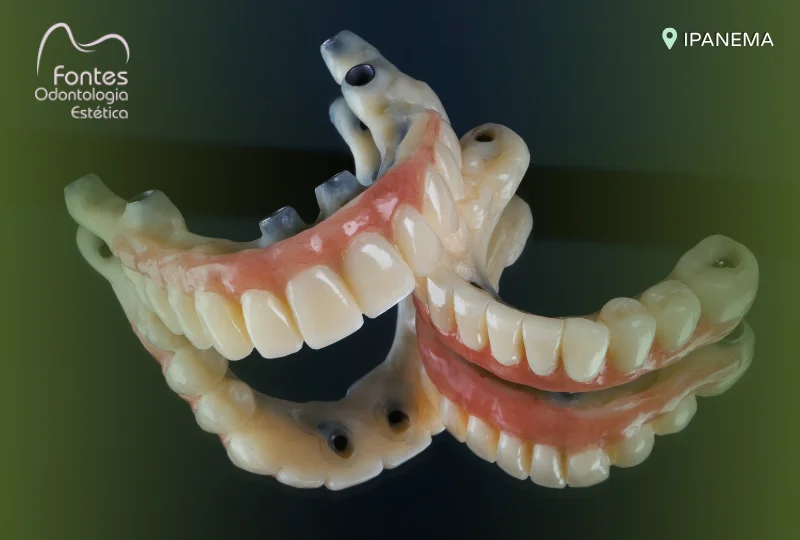
The term All-on-4 appears in searches about both types and techniques. Here, we analyze it exclusively from a technical perspective.
All-on-4 is a surgical protocol that uses four strategically positioned implants to support a fixed full prosthesis. The main feature of this technique is the angling of the back implants, which makes better use of the available bone, especially in the upper jaw.
What sets this technique apart?
Unlike conventional parallel placement, the All-on-4 protocol uses:
- Two front implants placed vertically
- Two angled back implants
- Strategic distribution of chewing load
This angling widens the support area and may reduce the need for a bone graft in certain cases.
Is All-on-4 a type or a technique?
Conceptually:
- Full arch → is a type of rehabilitation (structure)
- All-on-4 → is a technique for carrying it out
This distinction is important to avoid confusing structure with method.
When can the protocol be considered?
It is usually considered when:
- All the teeth have been lost
- There is limited bone at the back of the jaw
- An alternative to grafting is sought in certain scenarios
Whether it is indicated depends on individualized planning and a three-dimensional analysis of the arch.
To understand how this approach is applied clinically in a full rehabilitation, see our page on full-arch dental prostheses.
Next, we bring together the criteria that really determine the choice of the ideal technique in each case.
How does the dentist choose the ideal technique?
Choosing a dental implant technique does not start in surgery.
It starts with diagnosis.
Before deciding whether the case will be handled with immediate loading, guided surgery, bone grafting or the All-on-4 protocol, the professional assesses a set of clinical and structural factors that determine how predictable the treatment will be.
1️⃣ Detailed clinical assessment
The clinical examination makes it possible to analyze:
- The condition of the gums
- Any inflammation or infection
- The prosthetic space available
- The relationship between the upper and lower jaws
This stage defines limits and possibilities.
2️⃣ Three-dimensional imaging
A CT scan is one of the main planning tools.
It makes it possible to measure:
- Bone height
- Bone thickness
- Proximity to important anatomical structures
- Bone density
Based on this information, it becomes possible to assess whether a graft is needed, whether immediate loading is viable or whether the case requires another technical approach.
3️⃣ Prosthetic planning
The implant is not placed in isolation.
The chosen technique must take into account the final result of the prosthesis, including:
- The position of the teeth
- The look of the smile
- The distribution of chewing force
- Space for cleaning
That is why, in some cases, computer-guided surgery may be integrated into planning, while in others the conventional technique is entirely adequate.
4️⃣ The patient’s general health
Systemic diseases, medication and habits such as smoking also influence the technical decision.
These factors do not determine the type of implant, but they can influence how it is placed.
The technique is a personalized decision
There is no standard technique that applies to every patient.
The choice involves:
- Anatomical analysis
- Functional planning
- Risk assessment
- The final prosthetic goal
So when researching dental implant techniques, it is important to understand that each method has specific indications and must be chosen based on an individual diagnosis.
This concludes our overview of the main technical approaches used today.
🦷 Related treatment in Ipanema: Dental Implants · Immediate Load Implants · Bone and Gum Grafts