Losing one tooth changes the way you chew. Losing several changes the way you see yourself.
When someone starts researching types of dental implants, they have usually moved past the question of whether to get implants. The question is now: which dental implant is best for my case? And that is the right question — because there is no single option that works for everyone.
The choice is not determined by aesthetics alone. It depends on the number of missing teeth, bone quality, their position in the dental arch, the time available for treatment, and even the patient’s oral health history. That is why there are options such as single-tooth implants, multiple implants, full-arch implants, and zygomatic implants — each with a specific indication.
In this article, you will understand:
- When a single-tooth implant is indicated
- When to choose multiple implants
- How a full-mouth (full-arch) implant treatment works
- When a zygomatic implant becomes necessary
- And, most importantly, what truly determines which type of dental implant is best
1. Single-tooth implant
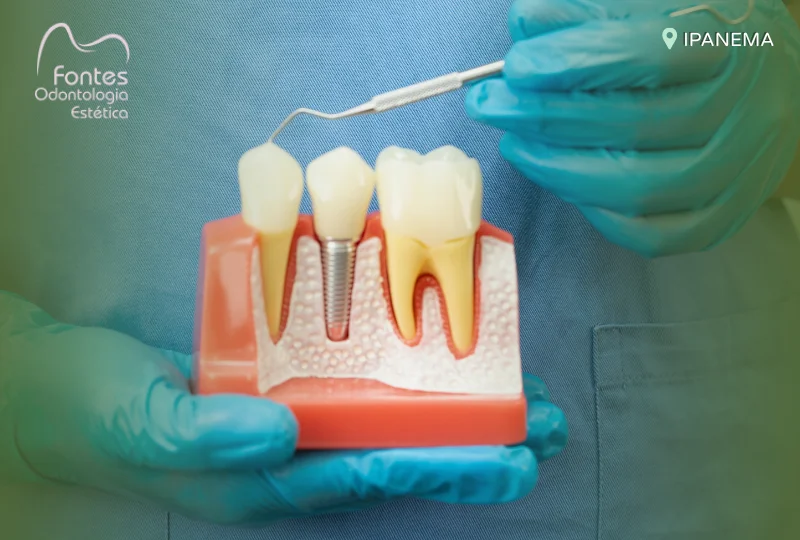
A single-tooth implant is indicated when only one tooth is missing.
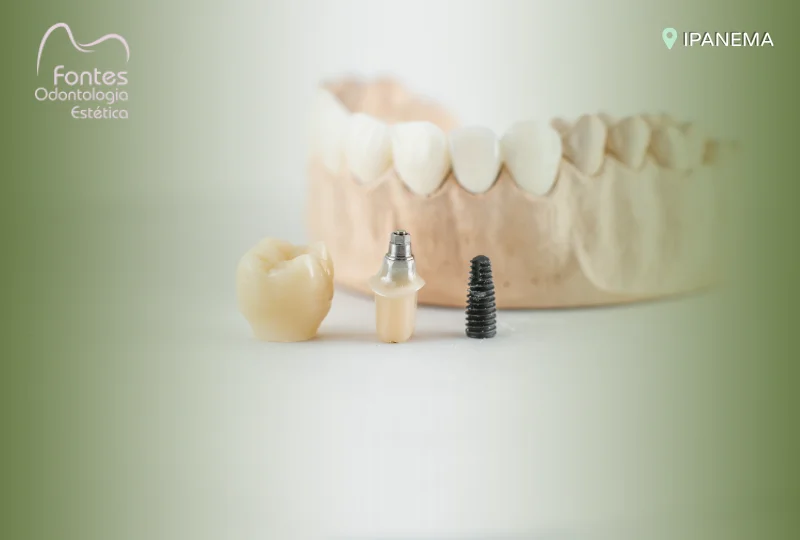
It replaces the natural root with a titanium post placed in the bone, on which a custom dental crown is secured. The result is a tooth with an appearance and function very close to a natural tooth, without the need to reshape adjacent teeth — as was necessary with traditional fixed bridges.
When is a single-tooth implant indicated?
- Loss of a single tooth
- Irreversible root fracture
- Extensive decay that cannot be restored
- A tooth that has been missing for years with adequate bone preservation
This type of individual implant is very common in the posterior region (molars), where chewing forces are greater. However, it is also widely used in the anterior region, where aesthetic demands are higher.
How does the process work?
In practical terms, treatment involves:
- Clinical assessment and imaging examination
- Placement of the implant in the bone
- Osseointegration period (integration of the implant with the bone)
- Placement of the final crown
In some specific cases, immediate loading may be recommended, in which a temporary crown is placed on the same day. (Recommended anchor: immediate loading → link to the corresponding service page)
Advantages of a single-tooth implant
- Preserves adjacent teeth
- Maintains the bone structure of the area
- Provides stability when chewing
- It is not removable
- Offers high durability when properly indicated
Unlike a removable partial denture, a single-tooth implant does not rely on support from other teeth. It functions independently.
When is it not the best choice?
Not every patient can receive an implant immediately. There may be:
- Significant bone loss
- Active periodontal disease
- A prior need for bone grafting
In these cases, treatment planning may involve additional steps before implant placement.
If more than one adjacent tooth is missing, placing individual implants may not be the most efficient approach. This is where the next scenario comes in.
2. Multiple implants
Multiple implants are indicated when two or more teeth are missing in the same area of the dental arch.
Unlike a single-tooth implant, treatment planning in this case takes into account the distribution of chewing forces between implants and the possibility of using an implant-supported fixed bridge to connect the replacement teeth.
When are they indicated?
- Loss of consecutive teeth
- Absence of three or more adjacent teeth
- Cases in which there is no need to replace the entire dental arch
Instead of placing one implant for each missing tooth, the dentist may choose, for example, two implants to support three teeth. This decision depends on bone assessment and the biomechanics of the area.
This type of rehabilitation is common in patients with partial tooth loss, especially in the posterior region, where chewing requires greater stability.
Difference from a removable denture
Many patients still confuse multiple implants with a removable partial denture.
The difference is structural.
A removable denture rests on the gums and may move. Multiple implants, on the other hand, are fixed to the bone, providing:
- Greater stability
- More efficient chewing
- Lower risk of overloading natural teeth
- A feeling closer to that of natural teeth
In addition, implants help preserve bone volume in the area, preventing the progressive resorption that often occurs after tooth loss.
When are they not the best solution?
If all teeth in the dental arch are missing, multiple implants alone are no longer the most appropriate alternative. In this situation, full-arch rehabilitation is considered, as it follows a different structural approach.
3. Full-arch implants
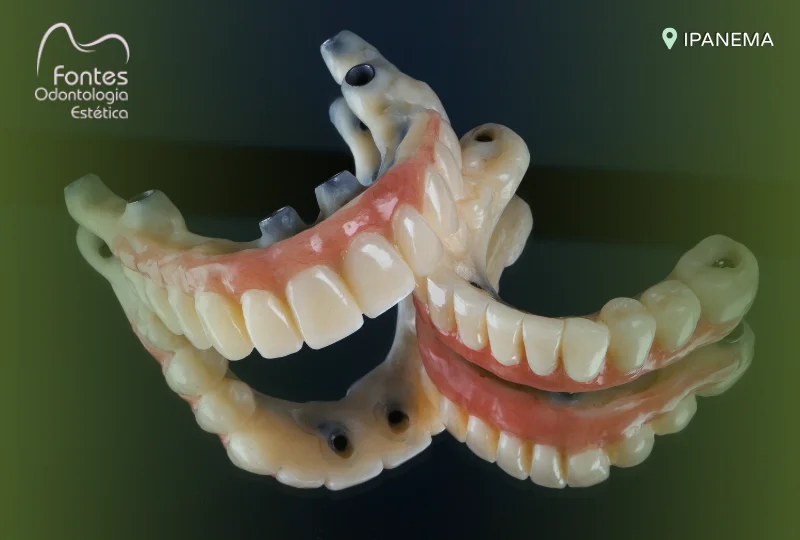
A full-arch implant treatment is indicated when the patient has lost all upper teeth, lower teeth, or both.
In this situation, we are not talking about replacing one or two teeth, but about restoring the chewing function and aesthetics of an entire dental arch. The structural approach changes completely.
When is it indicated?
- Complete tooth loss
- Long-term denture use with instability
- Remaining teeth with severe compromise
- Progressive bone loss associated with missing teeth
Unlike a traditional removable denture, which rests only on the gums, a full-arch implant treatment is secured to implants placed in the bone. This provides stability when chewing, speaking, and smiling.
How does it work structurally?
Instead of placing one implant for every missing tooth, a strategic number of implants is used to support a complete fixed prosthesis.
This structure may vary according to individual treatment planning, but the goal is always the same: to restore function, stability, and biomechanical predictability.
In some specific cases, it may be combined with the immediate loading technique, allowing a temporary prosthesis to be placed in less time.
Difference from multiple implants
Although both involve more than one implant, multiple implants treat partial tooth loss. Full-arch implants, on the other hand, provide complete rehabilitation.
The main difference is the extent of rehabilitation:
- Multiple implants → replace part of the dental arch
- Full arch → replaces all teeth in one dental arch
In addition, the functional impact is broader, as it involves the complete redistribution of chewing forces.
What influences the indication?
Some factors determine treatment planning:
- Bone quality and volume
- History of removable denture use
- Systemic health conditions
- The patient’s functional expectations
For example, when there is severe bone loss in the posterior maxilla, it may be necessary to consider a different structural alternative — such as a zygomatic implant, which we will discuss next.
4. Zygomatic implant
A zygomatic implant is indicated in specific situations, generally associated with pronounced bone loss in the upper jaw.
When a patient has severe bone resorption in the maxilla, especially after many years without teeth or long-term denture use, there may not be enough bone volume to support conventional implants. In these cases, anchorage is achieved in the zygomatic bone, which has greater density.
In which situations is it considered?
- Advanced bone loss in the maxilla
- Inability to place traditional implants
- Cases in which bone grafting is not feasible or is not the first choice
A zygomatic implant is not an aesthetic or optional variation. It is a structural solution indicated when the patient’s anatomy limits conventional alternatives.
What makes it different from other types?
While single-tooth, multiple, or full-arch implants use the alveolar bone — where the teeth were located — a zygomatic bone implant uses a deeper bone structure located in the cheekbone area.
This difference changes the treatment planning, but the final goal remains the same: to provide fixed support for a stable prosthesis.
It is important to note that it does not replace full-arch implant treatment. In practice, it may be part of complete rehabilitation when there is significant bone deficiency.
(Recommended anchor: zygomatic implant → link to the corresponding service page)
When is it not necessary?
If there is sufficient bone volume in the maxilla, conventional implants are usually chosen. Zygomatic implants are indicated in specific situations and are not the first choice in every case of complete tooth loss.
This concludes the main types of dental implants used according to the extent of tooth loss and bone conditions.
Which type is best?
This is the most searched question: which dental implant is best?
The direct answer is: it depends on your clinical condition.
There is no universally “best type.” There is a type that is most suitable for each situation. The right choice takes into account bone structure, the number of missing teeth, their position in the dental arch, and the functional objective.
To make comparison easier, see a brief overview:
| Type of Implant | Main Indication | Extent of Tooth Loss | Supporting Structure |
| Single-tooth implant | Loss of a single tooth | Localized | One implant for one crown |
| Multiple implants | Partial tooth loss | Two or more consecutive teeth | Two or more implants supporting a fixed prosthesis |
| Full arch | Complete tooth loss | Entire dental arch | Fixed structure supported by implants |
| Zygomatic implant | Severe bone loss in the maxilla | Usually the upper arch | Anchorage in the zygomatic bone |
Notice that the decision does not begin with the “type.” It begins with the diagnosis.
What truly determines the choice?
Some factors carry more weight in the indication:
- Number of missing teeth
- Volume and quality of available bone
- How long teeth have been missing
- History of removable denture use
- The patient’s systemic health conditions
For example:
- If one tooth is missing → a single-tooth implant is usually sufficient.
- If there is partial tooth loss → multiple implants may offer better force distribution.
- If all teeth are missing → full-arch rehabilitation is generally more appropriate.
- If there is significant bone deficiency in the maxilla → a zygomatic implant may be considered.
Each structure addresses a different problem.
Is there an implant that is safer or more durable?
Durability does not depend only on the type of implant, but also on:
- Proper treatment planning
- Quality of placement
- Oral hygiene
- Regular follow-up care
When properly indicated, any of these types can offer long-term functional predictability.
Therefore, when searching for “which implant is best,” the most accurate answer is: the best implant is the one that addresses your specific case with stability and structural safety.
Understanding the differences is already an important step. The next is to individually assess the condition of your dental arch to identify which of these solutions truly applies to your situation.
Frequently Asked Questions About Types of Dental Implants
Is there a type of implant that is more suitable for older adults?
There is no specific type based on age alone. The choice depends on the number of missing teeth, bone quality, and general health conditions, not exclusively on the patient’s age group.
Does someone who has lost many teeth always need full-arch implants?
Not always. If the tooth loss is partial, multiple implants may be sufficient. The correct indication depends on the actual extent of missing teeth and the clinical assessment.
Does a zygomatic implant replace a conventional implant?
No. A zygomatic implant is mainly indicated when there is severe bone loss in the maxilla. It does not replace conventional implants when adequate bone volume is available.
Is it possible to combine different types of implants in the same treatment?
Yes. In some cases, conventional implants may be used in one part of the dental arch and zygomatic implants in another region, according to structural needs.
Does the type of implant affect durability?
Durability is more closely related to treatment planning, proper placement, and maintenance than to the type itself. When properly indicated, any type can offer long-term stability.